
Vending machines, micro markets, office coffee and pantry programs serve more than 40 million American consumers every day at work, home, school and play, according to the National Automatic Merchandising Association (NAMA). Of those formats, the micro market is the one that looks most like a real store.
If your breakroom has outgrown a couple of vending machines, it’s probably the option you’re weighing. Here’s how a micro market works, which sites it fits, and how employers set them up at one location or many.
What is a micro market?
A micro market is a small, unattended store inside your workplace. NAMA describes micro markets as unattended retail spaces where shoppers pick products from shelves and open coolers, then pay at a self-checkout kiosk with a cashless payment system.
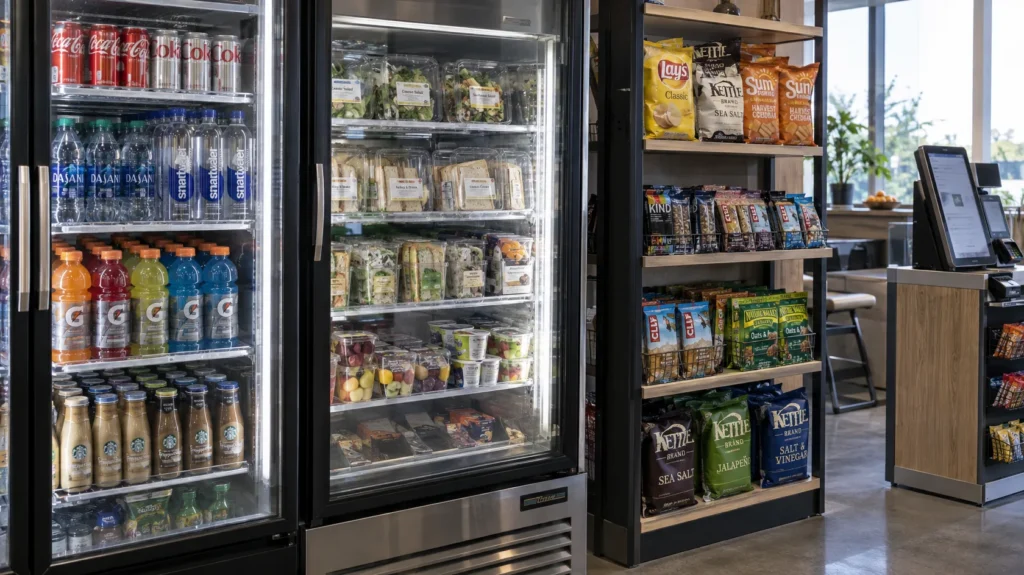
Employees walk up, pick up a salad or a cold brew, read the label and check out on their own. A typical market combines:
- Open shelving for chips, bars, nuts, candy and other shelf-stable snacks
- Coolers for fresh meals, sandwiches, fruit, yogurt and drinks
- A self-checkout kiosk where employees scan items and pay with a card or another cashless method
The operator handles the upkeep. A route driver restocks the shelves, pulls expired items and adjusts the product mix based on what sells.
How it differs from vending
A vending machine keeps every item behind glass, which limits how many products fit and makes fresh food harder to sell well. A micro market has far more room, so the selection runs wider: full meals, fruit, specialty drinks, allergen-conscious snacks and seasonal items.
The tradeoff is security. Products sit on open shelves, so micro markets work best where access is limited to employees. Our guide to smart stores covers the locked, tap-to-open alternative for areas where open shelving isn’t practical.
Does your site have the space and headcount?
As a rule of thumb, micro markets need 150 to 300 square feet, work best in secured badge-access areas and serve locations with 100 or more daily users. Treat those numbers as a starting point. A provider will also look at:
- Shifts: A distribution center running around the clock gets more use from the same footprint than a 9-to-5 office.
- Nearby food: Sites far from restaurants and convenience stores see more breakfast and lunch traffic.
- Power and connectivity: Coolers and the kiosk need power, and the kiosk needs a network connection to process payments.
Sites that come up short on space or traffic still have options. A smaller office might be better served by a vending machine or a smart cooler today, with room to add a market as headcount grows.
Subsidy options
In the standard model, employees pay for what they take. Many employers go further and cover part or all of the cost as a perk. The common setups are:
- Full subsidy: The company pays for everything employees take.
- Allowance: Each employee gets a set amount to spend.
- Percentage: The company covers a share of each sale.
A subsidy changes how people use the market. Employees who would have left for lunch eat on site, and the market becomes a visible benefit during recruiting. Our page on subsidized micro markets explains how employers weigh the added cost against hiring and retention.
Stock it so the healthy options get picked
Because shoppers see and handle every product, the layout of a market shapes what people buy. The CDC notes that behavioral design, including product placement and layout, can increase selection of healthier foods and beverages in cafeterias, micro markets and vending machines.
In practice, that means fruit, salads and water in the most visible cooler spots, with the product mix tied to what employees ask for. A good operator reviews sales data and rotates slow sellers out.
Rolling out micro markets across multiple locations
One micro market is a straightforward project. Ten of them across five states is harder. Each location usually needs a local operator to stock it, and each operator brings its own agreement, product mix, kiosk and service standards. Procurement ends up managing a stack of vendors for one amenity, and employees who visit other sites find a different market at each stop.
A few habits make a multi-site rollout smoother:
- Start with the strongest sites. Locations with the most people and the most shifts prove the concept fastest.
- Set policy centrally, stock locally. Decide subsidy rules once, then let each market’s product mix follow its own sales.
- Ask for reporting by site. Comparable sales data shows which markets need a different mix or a different format.
Guardian Refresh partners with vetted local operators nationwide and manages the program through a single point of contact, whether you have one location or hundreds. Each site gets a market customized to its team, set up and restocked by a provider who knows the area. Your team keeps one relationship and one place to call.
Getting started
Tell us how many locations you have, roughly how many people work at each, and whether you’re considering a subsidy. A Guardian Refresh representative will design a program at no cost. Learn more about our office micro markets or contact us to see which of your sites are a fit.