
Employee retention is one of the most expensive challenges businesses face. Replacing a single employee can cost anywhere from 30% to 200% of their annual salary, depending on the role (SHRM). Multiply that across a few departures a year, and the numbers add up fast.
So it’s no surprise that HR leaders are looking for every advantage they can get. And increasingly, they’re looking at a space that used to be an afterthought: the breakroom.
Small Perks, Big Impact
It might seem like a stretch to connect snacks and coffee to something as serious as employee retention. But the research tells a different story.
According to recent workplace surveys, 56% of workers say they’ve stayed longer at a company because of great breakroom perks (Maumee Valley Group). And 78% of employees say that access to food at work makes them feel more valued.
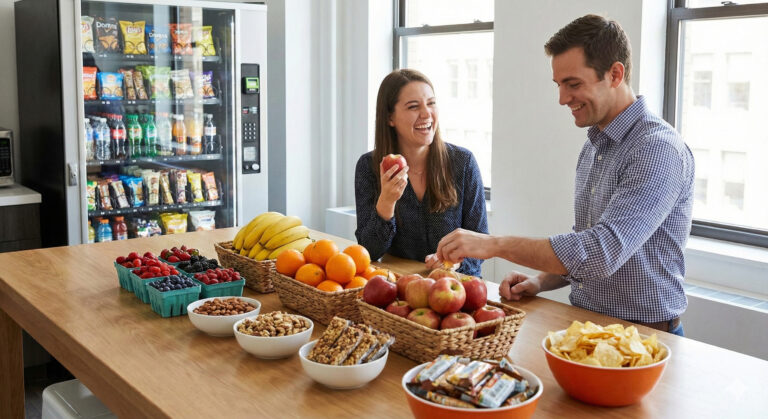
That feeling of being valued matters. Gallup research shows that employees who feel appreciated are 63% less likely to actively look for a new job. When someone feels like their employer pays attention to the details, from the coffee quality to the snack selection, it sends a message about how much the company cares.
The ROI of a Better Breakroom
For skeptics who see breakroom upgrades as a “nice to have,” consider the math. Industry research suggests that breakroom investments can yield up to 150% ROI in employee retention (Commonwealth Joe). Given that losing a mid-level employee can cost tens of thousands of dollars in recruiting, onboarding, and lost productivity, a few hundred dollars a month on better coffee and snacks starts to look like a bargain.
There’s also the productivity angle. Workers who take regular breaks and eat nutritious food during the day are measurably more productive. One study found that employees who eat well are 25% more productive than those running on vending machine candy bars and energy drinks (Maumee Valley Group).
It’s Not Just About Free Stuff
The breakroom isn’t just a place to grab a snack. It’s one of the few spaces in an office where people from different departments cross paths, where informal conversations happen, and where workplace culture gets built.
According to workplace research, 68% of employees say shared food experiences help build stronger workplace culture. Teams with a shared break space report 35% stronger collaboration (Maumee Valley Group). And in a Zerocater survey, 90% of employers said that providing meals and snacks helped employees build stronger relationships with their colleagues.
In other words, the breakroom isn’t just fueling individuals. It’s fueling connection.
What This Means for Your Business
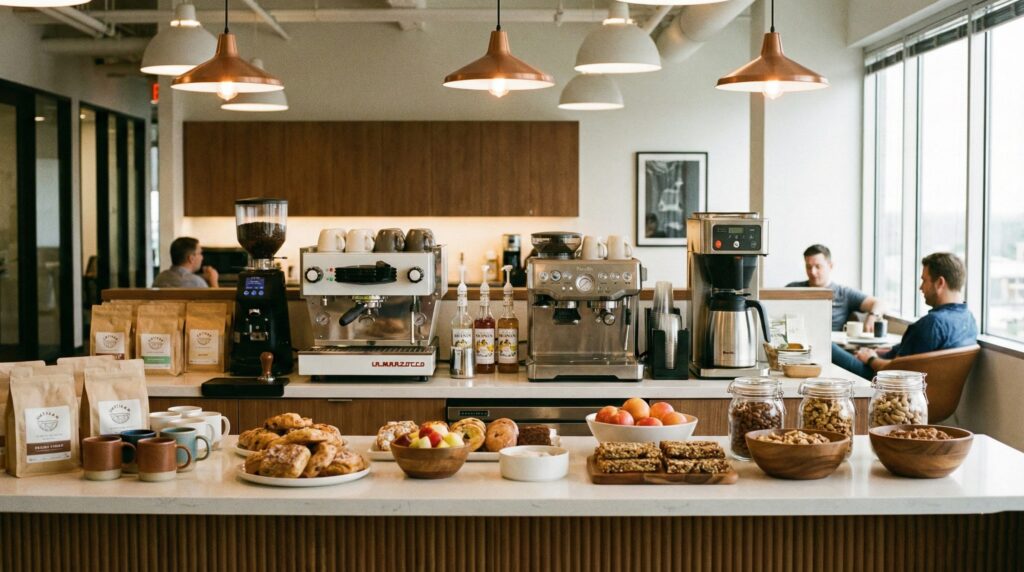
You don’t need a Silicon Valley budget to make your breakroom work harder. Often, it’s about paying attention to the basics: quality coffee, a mix of healthy and indulgent snacks, beverages beyond the standard soda options, and a space that feels clean and welcoming.
The companies getting this right aren’t necessarily spending the most. They’re just being intentional. They treat the breakroom as part of the employee experience rather than an operational afterthought.
With 87% of HR leaders citing retention as a critical priority in 2025 (Gartner), every lever matters. The breakroom might not solve your retention challenges on its own. But it’s a visible, daily signal that tells employees their comfort and wellbeing are worth investing in.
Sometimes, that’s exactly what keeps someone from looking elsewhere.